
Most organizations measure whether the roster is full. Very few measure whether the workforce is productive. That gap is where labor cost, burnout and service failures quietly accumulate, and no scheduling tool, however polished, closes it on its own.
The uncomfortable truth: a perfect roster still fails
A schedule is a forecast about the future, published before the future happens. The moment three people call in sick, demand spikes, or one department overruns while another sits idle, the roster stops describing reality. What remains is a manager with a phone, a spreadsheet and incomplete information.
If your workforce process ends at “the roster is published”, you are managing a plan, not a workforce. Three questions expose this quickly:
- Do you know, today, how far actual hours differ from planned hours in each department?
- Can you redeploy people across teams or sites within the shift, rather than after the damage is done?
- Does what happened last month change how you build next month’s schedule?
If the honest answer to any of these is no, the problem is not scheduling. It is that the process around scheduling does not exist.
The strategic case: your largest controllable cost, run on guesswork
For most labor-intensive businesses, workforce spend is the biggest operating line that leadership can actually influence. In healthcare, aviation, telecom, retail and facilities, it is also the line most directly tied to service quality, safety and compliance.
Yet in many organizations it is governed by habit: last year’s roster, a manager’s instinct, an overtime approval at 6 pm. Three strategic risks follow.
- Cost opacity. Overtime, agency cover and idle hours are visible only in the payroll report, weeks after the decision that caused them.
- Capacity blindness. Leaders cannot answer “where are we under- and over-staffed right now?” without asking several people.
- Transformation stall. Automation, new service lines and market expansion all depend on knowing what your workforce can deliver. If that is unknown, every plan rests on assumptions.
Workforce optimization turns the workforce from a cost to be administered into a system to be managed: planned against demand, observed in real time, and improved every cycle.
Four stages, only one of which is the roster
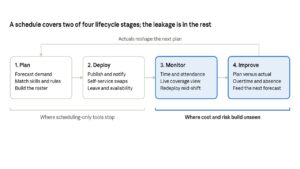
Most organizations invest heavily in stages one and two, then run stages three and four on phone calls and spreadsheets. That is why the roster can look fine while the labor cost line does not.
Plan against demand, not against last year’s roster
Many rosters are built by repetition: the same headcount on Monday morning because that is how Monday morning has always been staffed. But demand does not repeat that politely. Store footfall, patient admissions, passenger flows, call volumes and production runs all move by the hour, the day and the season.
A fixed headcount against a moving demand curve is wrong in both directions at once. It overstaffs the quiet hours, which you pay for, and understaffs the peaks, which you pay for in overtime, service failures and tired people.
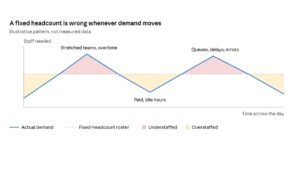
Demand-led planning reverses the logic. Historical operational data is analyzed to forecast when requirements will rise and fall, and shifts are built around that curve, while skills, leave and working-hour rules are respected. The roster becomes an output of demand, not an assumption.
Attendance data is where the plan meets the truth
Planned hours and worked hours are rarely the same. People arrive late, leave early, stay on, swap informally or simply do not turn up. If that gap is captured late, inaccurately or not at all, the organization is steering on a map that no longer matches the ground.
Accurate time and attendance data closes the loop. Managers can compare scheduled against actual hours and see the patterns that cost money:
- Recurring overtime in the same teams, which signals a rostering or capacity problem, not a people problem.
- Absence clusters by shift, site or manager, which point to causes that a headcount buffer only hides.
- Chronic over-runs in departments that always need more labor than planned, which means the forecast itself is wrong.
The point is not surveillance. It is feedback. Treated as a back-office payroll task, attendance data is only paperwork. Fed back into planning, it is the cheapest source of improvement an organization has.
Employee experience is an operational variable, not a perk
It is tempting to treat wellbeing as a separate HR topic and optimization as a cost topic. In practice they are the same system. A workforce that is overworked, scheduled unfairly or given no say in its working patterns does not stay productive for long. It leaves, calls in sick, or disengages, and every one of those outcomes lands back on the operations and cost lines.
The scheduling decisions that cause this are specific and avoidable: repeated undesirable shifts, excessive overtime, too little rest between shifts, and last-minute changes with no warning.
Modern workforce optimization treats preferences and wellbeing as inputs alongside demand and cost. In practice that means employees can:
- see their schedules early and on their own devices
- request leave and state availability
- swap shifts within the rules
- volunteer for extra work when they want it
The result is fewer surprises for managers and more control for employees, which is the combination that sustains both retention and coverage.
Audit your current process: eight honest questions
Before evaluating any tool, assess what you do today. Answer each question as it is, not as you wish it were. Every “no” is a place where cost or risk is currently invisible.
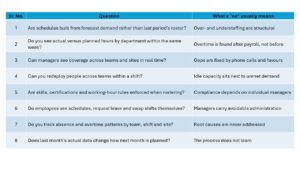 Three or more “no” answers mean the issue is not the quality of your roster. It is that your workforce process is open-loop.
Where does your organization sit?
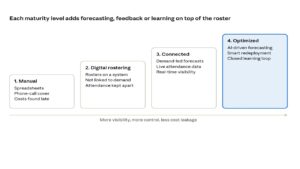
The levels are cumulative. Moving from one to the next is not about buying software for its own sake. Each step adds one specific capability: a system of record, a link to demand, a feedback loop from attendance, and finally a model that learns from outcomes. Be honest about which level you operate at today, because the cost of staying there compounds as operations get more complex.
The next phase: from managing a workforce to optimizing it
Spreadsheets and standalone rostering tools can carry an organization to level two. Past that, the problem is not a missing feature. It is that planning, attendance, visibility and analytics sit in different places, so nobody can act on the whole picture in time.
This is the gap an AI-powered workforce management platform like Workforce Optimizer (WFO) is built to close. It connects the stages of the lifecycle into one system:
- Plan around forecast demand and the skills and rules that apply, rather than static staffing assumptions.
- Deploy with employee self-service for availability, leave and shift swaps, so managers stop acting as a switchboard.
- Monitor actual attendance and coverage across departments and locations, so gaps and overtime show up while they can still be fixed.
- Improve with analytics that feed actual workforce behavior back into the next plan.
For organizations in healthcare, aviation, telecom, retail and facilities, where demand shifts constantly and workforce cost is large, that connection is what turns workforce data from a reporting exercise into a decision-making advantage. It also makes the workforce transformation that leadership is planning possible, because you cannot redesign what you cannot see.
Conclusion: ask a harder question
Scheduling is necessary and nowhere near sufficient. A full roster tells you that shifts are covered. It does not tell you whether demand was met efficiently, whether costs leaked, or whether the people doing the work can sustain it.
For organizations facing rising labor costs, workforce shortages and growing operational complexity, the question is shifting from “Is the roster complete?” to “Are we getting the most value from our workforce?”
If your honest audit above turned up several gaps, that is useful information, not a failure. It tells you where the next phase of your workforce transformation should start.
Want to see how this works in practice? Speak to our team to learn more.






 622 Lor 1, Toa Payoh
 sales@workforceoptimizer.com
