

Employee experience has become one of the biggest priorities for organizations across every industry. While companies invest heavily in workplace culture, employee benefits, and modern office spaces, one factor is often overlooked: the work schedule itself.
For the deskless employees working shifts, their roster has a direct impact on almost every aspect of their working life. It determines when they work, when they rest, how much time they spend with family, and whether they feel their employer values their personal commitments.
When scheduling is inconsistent, unfair, or managed manually, no amount of workplace perks will prevent turnover. Thus, in today’s competitive labor market, HR and operations leaders are realizing that a great employee experience starts with a better schedule.
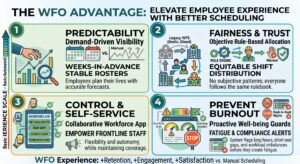
Greater Predictability Supports Work-Life Balance
One of the greatest stressors for frontline workers is schedule instability. Being notified of a shift change at the last minute or working a volatile roster makes it nearly impossible to plan childcare, family commitments, education, or even personal time.
This uncertainty often creates unnecessary stress that extends beyond the workplace.
Better scheduling practices provide employees with greater predictability by leveraging accurate demand forecasting to publish optimized rosters weeks in advance. Publishing rosters earlier, reducing unnecessary last-minute changes, and giving staff visibility into upcoming shifts simply reduces stress.
When employees have confidence in their schedules, they can better balance their professional and personal responsibilities, leading to higher job satisfaction and engagement. They aren’t just working a job, they are managing a sustainable life.
Organizations also benefit, as employees who can plan their lives are generally more reliable, experience fewer scheduling conflicts, and are less likely to request last-minute leave.
Fair Scheduling Builds Trust
One of the quickest ways to damage employee morale is when staff perceive that schedules are unfair.
When done manually, managers often face dozens of competing priorities while building schedules. Without the support of workforce planning tools, it can be difficult to balance employee preferences, operational requirements, leave requests, skill requirements, and compliance rules fairly across an entire team.
Over time, employees may begin to notice patterns where certain individuals consistently receive preferred shifts, weekends off, or public holiday leave, while others are repeatedly assigned undesirable or demanding shifts.
Whether or not this is intentional, the perception of unfairness can significantly affect employee trust.
Modern systems help remove much of this subjectivity by applying consistent scheduling rules across the workforce. Shift allocations can take into account employee availability, rotation patterns, total hours worked, previous shift assignments, organizational policies, and balance, helping create schedules that are more equitable.
Giving Employees More Control
Employee experience improves significantly when employees have some level of control over their schedules.
Traditional scheduling often leaves staff feeling that schedules simply happen to them, with little opportunity to influence when or how they work.
Modern workforce management systems introduce self-service capabilities that allow employees to participate in the scheduling process and offer flexibility. This can include:
- Indicating shift preferences
- Swapping shifts between each other
- Updating availability
- Volunteering for additional shifts
Providing employees with greater flexibility doesn’t mean compromising operational requirements. Instead, it creates a collaborative scheduling process where both organizational needs and employee preferences can be considered.
Employees who feel they have greater ownership over their work schedules are generally more engaged and more satisfied with their overall work experience.
Reducing Burnout Through Smarter Scheduling
Manual scheduling can unintentionally create fatigue by assigning employees to consecutive night shifts, insufficient rest periods, excessive overtime, or demanding shift rotations over extended periods.
While these issues may initially appear manageable, repeated exposure can contribute to physical exhaustion, reduced productivity, increased absenteeism, and eventually employee burnout.
Smarter workforce planning helps managers identify these risks before schedules are published. Modern scheduling systems can automatically consider rest requirements, maximum working hours, workload distribution, and fatigue management policies when generating rosters.
And if either issue is still present in the roster, the system can flag this as a potential risk for manager review.
Conclusion
Employee experience is shaped by the everyday interactions employees have with their workplace, and few interactions occur more frequently than the work schedule itself.
Fair scheduling, greater flexibility, improved communication, and balanced workloads all contribute to a more positive employee experience while supporting operational performance.
As organizations continue to compete for talent, better scheduling is no longer simply an operational responsibility, it has become a strategic advantage. Investing in smarter workforce planning allows organizations to improve employee satisfaction, strengthen retention, and build a more engaged workforce capable of delivering consistently high levels of performance.
Are you looking to improve your employee experience in workforce planning? Speak to our team today to find out how.







 622 Lor 1, Toa Payoh
  sales@workforceoptimizer.com