
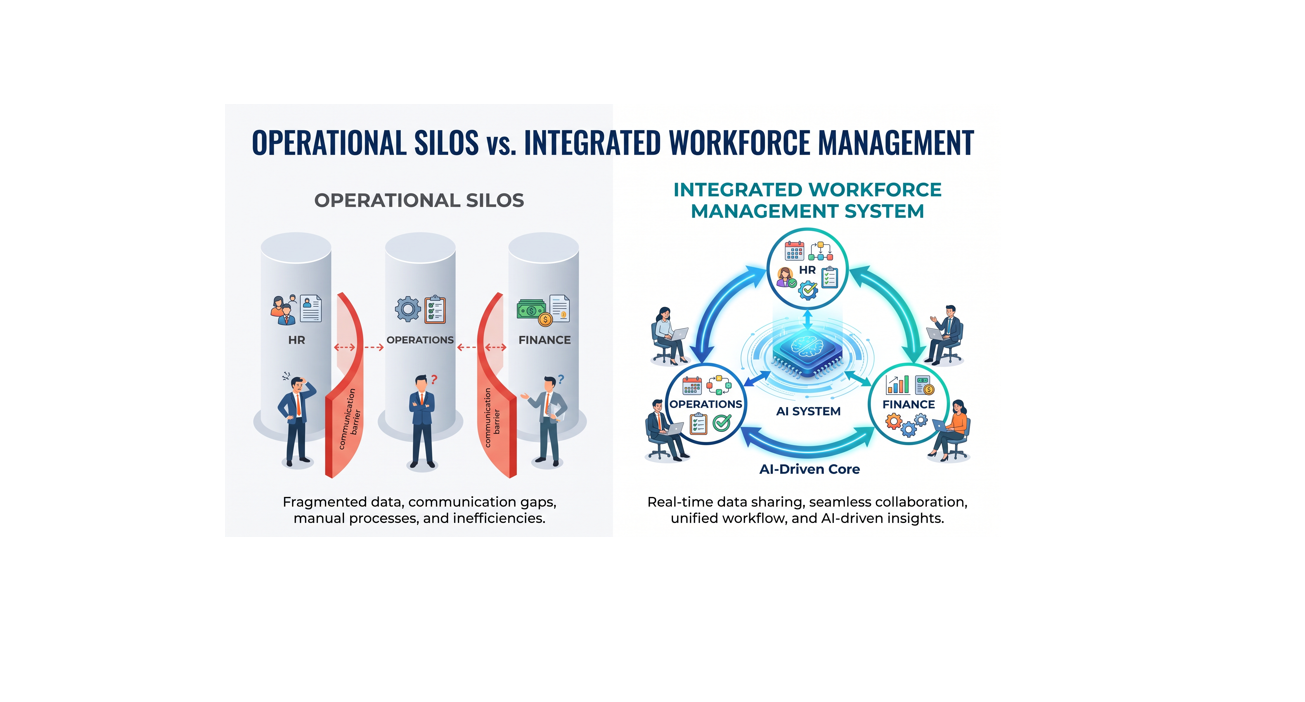
HOW INTEGRATED WORKFORCE SYSTEMS REDUCE OPERATIONAL SILOS
When scheduling, time, payroll and HR each live in their own system, every team works from a different version of the truth. Here is what that costs, and how a connected platform fixes it.
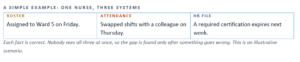
It is Friday afternoon and payroll closes at 5 pm. In a hospital network, a retail chain or an airport, HR plans hiring from static projections, Operations builds rosters in spreadsheets, Finance pays staff from separate time records, and frontline staff ask for leave on a messaging app. Every team is working hard. No two teams are looking at the same data.

THE PROBLEM
What is an operational silo?
That scramble has a name: the operational silo. A silo is a team, a system or a set of data that holds information other people cannot easily see or use. In workforce management, silos usually grow by accident.
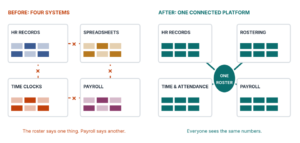
A hospital buys a rostering tool in one year, a payroll system in another and a time clock in a third. Each one does its job well. None of them talks to the others. Soon the roster says one thing, the time clock says another and payroll pays a third. Someone in the middle fixes the differences by hand, every pay period.
Nobody plans a silo. They build up as organisations grow, add sites and buy new tools. The cost stays hidden because each system looks fine on its own.
THE EVIDENCE
What fragmented workforce data costs
In 2026, Korn Ferry surveyed about 1,600 members of the C-suite on how their organisations manage talent data. The results show how common silos are, and how expensive.
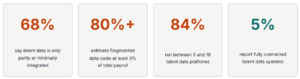

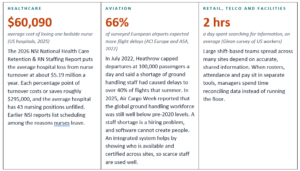
Time is lost too. A Glean workplace survey found that employees spend at least two hours a day looking for the documents, information or people they need. In the Korn Ferry survey, 26% of leaders said it can take weeks to get connected talent insights, and 31% said more than a quarter of their workforce is underutilised.
Poor visibility also leads to poor decisions. A Gartner survey found that 44% of users had made a wrong decision because they did not know about information that could have helped.
REAL-WORLD IMPACT
Where silos hurt most
Workforce silos matter most where staffing is tight, shifts run around the clock and mistakes are visible to the public.
THE RISKS
Five risks that silos create
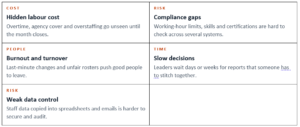
The damage shows up in four places: cost, time, people and risk.
THE FIX
How an integrated workforce system works
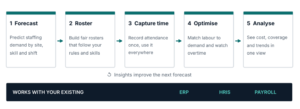
An integrated system treats workforce management as one loop instead of five separate jobs. Demand is forecast, a roster is built to meet it, time is captured as work happens, labour cost is checked against demand, and the results feed the next forecast.
FRONTLINE VIEW
Staff are part of the system too
Rosters fail when staff cannot use them. When staff can see their schedule, ask for leave and offer a shift swap from their phone, managers stop relaying changes by message, and the system stays up to date.
Predictable schedules are something an employer controls. NSI’s earlier nurse-retention reports list scheduling among the reasons nurses leave their hospitals.

SIDE BY SIDE
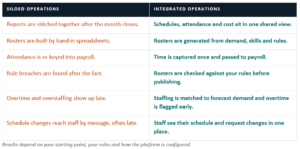
Before and after integration
WHAT THE LEADERS SEE
What changes when data is connected
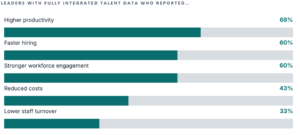
Korn Ferry asked leaders with fully integrated talent data what they gained. Confidence in workforce decisions rose from 4% to 55% among organisations that had integrated their data, according to coverage of the survey in HR Executive.
WORKFORCE OPTIMIZER
How WFO closes the gaps
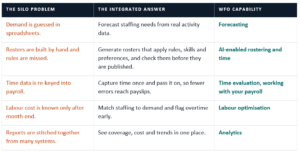
Workforce Optimizer (WFO) is an AI-powered workforce management platform. It is built for complex, regulated and round-the-clock operations such as hospitals, airports, ports and large retail networks. Each part of the platform answers a specific silo problem.
GETTING STARTED
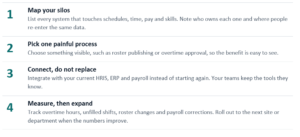
Four steps to fewer silos
You do not need to replace everything at once. Most organisations start small and grow.
Book a demo of one connected roster
Bring your sites, your systems and the places where silos cost you most. The Workforce Optimizer team will show you what an integrated approach looks like in your setting. To book a demo, Speak to our team today





 622 Lor 1, Toa Payoh
 sales@workforceoptimizer.com
