
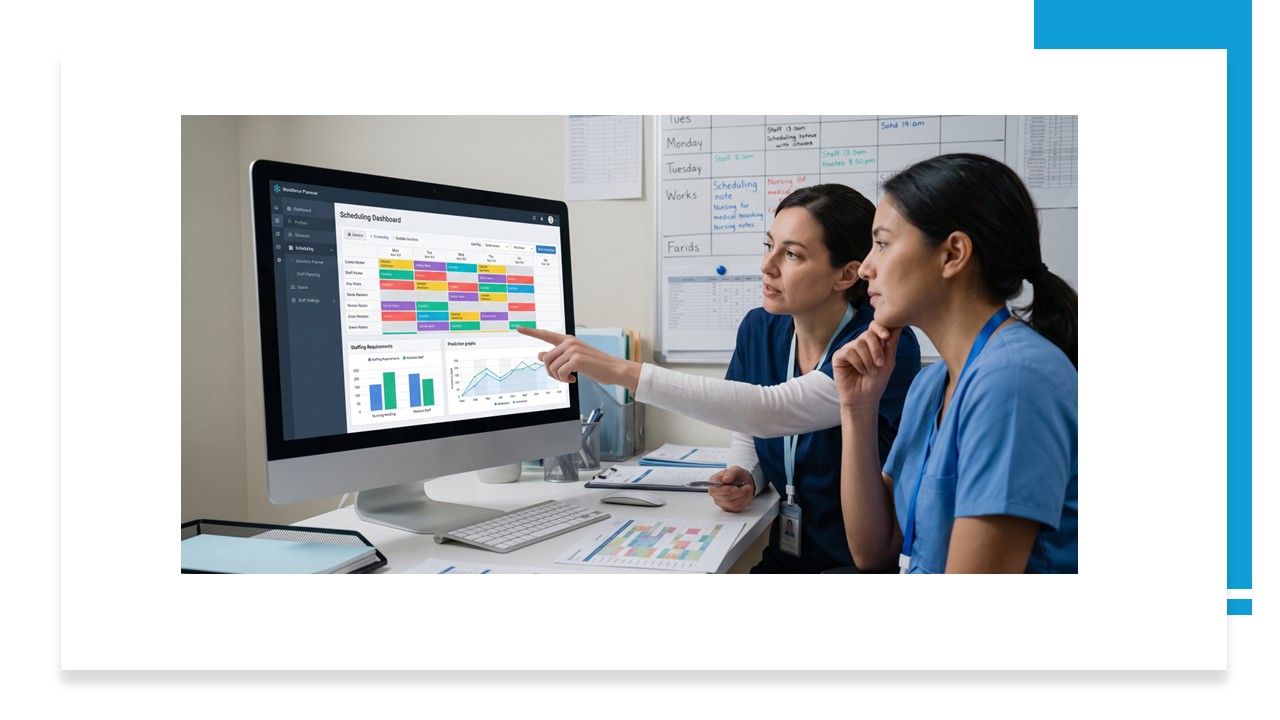
Healthcare systems around the world are facing a fundamental workforce challenge: demand for care is increasing while healthcare organizations continue to face pressure to attract, retain, and effectively deploy enough skilled staff.
An aging population, increasing patient volumes, workforce shortages, rising labor costs, and changing expectations among healthcare professionals are making workforce management more complex than ever.
While the global nursing workforce has grown, significant shortages and regional inequalities remain, with the World Health Organization projecting a global nursing shortage of around 4.1 million by 2030. The Ministry of Health, Singapore also expects the country’s healthcare workforce to grow from 129,000 in 2024 to around 156,000 by 2030, almost a 20% increase.
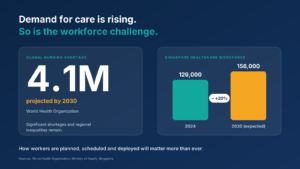
As healthcare demand increases, how effectively healthcare workers are planned, scheduled, and deployed will become more crucial.
Here are some of the key healthcare workforce trends to watch in 2026.
1. Healthcare Workforce Shortages Will Remain a Major Challenge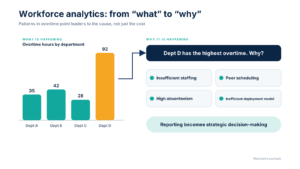
Healthcare workforce shortages are not a new problem, but they are becoming increasingly difficult for organizations to manage. Nurses, doctors, allied health professionals, and support staff are all critical to maintaining healthcare services, yet many healthcare systems continue to face challenges recruiting and retaining enough qualified workers.
The issue is not simply a lack of people entering healthcare professions. Organizations also need to consider retirement, attrition, migration, burnout, and the time required to train workers with specialized skills.
To solve this, hospitals can strengthen the local healthcare workforce pipeline, expand training pathways, improve retention, and supplement the workforce through foreign recruitment. But this creates a difficult balancing act for hospitals. Hiring additional staff is important, but recruitment alone cannot solve the problem if existing employees are not being utilized effectively or are leaving the profession.
As workforce shortages persist, hospitals will increasingly need to focus on getting more value from the workforce they already have. This means improving workforce utilization, reducing unnecessary administrative work, minimizing avoidable overtime, and ensuring skilled employees are deployed where they are most needed.
2. AI Playing a Bigger Role in Healthcare Scheduling
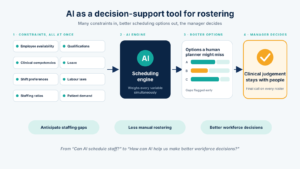
Artificial intelligence is increasingly moving from experimentation into practical workforce applications. Healthcare scheduling is particularly well suited to AI because of the sheer number of variables involved. A hospital roster may need to consider employee availability, qualifications, clinical competencies, leave, shift preferences, labor laws, staffing ratios, and patient demand, all at the same time.
Managing these variables manually becomes extremely difficult as workforce size increases. AI-powered scheduling can analyze these constraints simultaneously and identify scheduling options that may be difficult for a human planner to discover.
Importantly, this does not mean handing workforce decisions entirely over to AI. Healthcare managers still need to apply clinical judgement and understand the nuances of their teams. Instead, AI can act as a decision-support tool that helps managers identify better scheduling options, anticipate staffing gaps, and reduce the amount of manual work required to create and maintain rosters.
In 2026, the conversation around AI in healthcare workforce management will increasingly shift from “Can AI schedule staff?” to “How can AI help healthcare organizations make better workforce decisions?”
3. Flexible and Alternative Workforce Models Will Grow
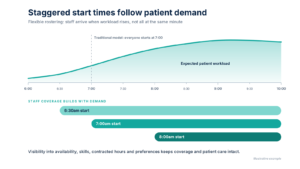 Healthcare organizations are also looking at more flexible ways to access workforce capacity. A traditional model may rely heavily on permanent full-time employees working predetermined shifts. However, this can make it difficult to respond to sudden changes in demand.
Part-time employees, casual staff, float pools, cross-trained employees, and other internal workforce resources can provide additional flexibility. For example, when an unexpected shift becomes available, a hospital may be able to offer it to a pool of qualified part-time or casual employees before asking an existing employee to work overtime. This creates a larger pool of available labor while giving employees greater flexibility over when they work.
Another area gaining importance is flexible rostering. Instead of requiring every employee to start a shift at exactly the same time, hospitals can introduce staggered start times based on actual patient demand and employee availability. For example, rather than having every employee begin a morning shift at 7am, a hospital may schedule some staff to start at 6:30am, others at 7am, and others at 8am, depending on when workload is expected to increase. This gives employees greater choice over when they work. Where operational requirements allow, staff may be able to indicate preferred start times or select from available shift options that fit better with their personal commitments.
The key is having sufficient visibility into employee availability, skills, contracted hours, and preferences. With the right workforce planning tools, hospitals can balance these variables while ensuring that flexibility does not come at the expense of staffing coverage or patient care.
4. Mobile Workforce Management Will Become the Norm
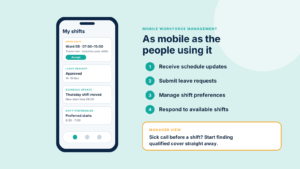
Healthcare workers are rarely sitting at a desk for the duration of their shift. Nurses move between wards, doctors move between departments, and support staff operate across different areas of a hospital. Expecting employees to access workforce systems exclusively through desktop computers creates unnecessary friction.
Mobile workforce management gives healthcare employees greater access to their schedules and workforce-related information wherever they are. Employees can receive schedule updates, submit leave requests, manage shift preferences, and respond to available shifts without relying on manual communication with supervisors.
For managers, mobile access can also make it easier to respond to staffing issues as they happen. If an employee calls in sick shortly before a shift, for example, managers can immediately begin looking for available qualified staff rather than waiting until they return to a workstation.
As healthcare becomes increasingly dynamic, workforce management will need to be just as mobile as the people using it.
5. Workforce Analytics Will Become More Important for Leaders

Healthcare organizations generate enormous amounts of workforce data. Historically, workforce reports may have focused on basic information such as headcount, attendance, or payroll. Increasingly, healthcare leaders will need deeper insights into how their workforce is performing and where operational inefficiencies exist.
Workforce analytics can help identify patterns in overtime, absenteeism, staffing shortages, workload distribution, employee utilization, and scheduling efficiency.
For example, if a particular department consistently generates higher overtime costs, leaders can investigate whether the problem is caused by insufficient staffing, poor scheduling, high absenteeism, or an inefficient deployment model.
This changes workforce management from an administrative reporting function into a strategic decision-making tool. Healthcare leaders can use workforce data to understand not just what is happening, but why it is happening and what can be done about it.
Conclusion
Healthcare workforce management is entering a period of significant change. Persistent workforce shortages, rising demand for healthcare services, employee retention challenges, and increasing operational complexity are forcing organizations to rethink how they plan and deploy their people.
The solution will not come from recruitment alone. Healthcare organizations will need to make better use of the workforce they already have through smarter scheduling, improved workforce visibility, flexible staffing models, data-driven forecasting, and increasingly intelligent technology.
For hospitals, the objective is not simply to have more employees. It is to ensure that the right healthcare professionals are available in the right place, at the right time, with the right skills to meet patient demand.
In 2026 and beyond, organizations that successfully combine workforce data, technology, and human expertise will be better positioned to control labor costs, support healthcare workers, and maintain high standards of patient care.
Want to learn how we are doing this for 20+ hospitals? Speak to our team to learn more.







 622 Lor 1, Toa Payoh
  sales@workforceoptimizer.com