

For many organizations, workforce planning has traditionally relied on manager experience, intuition, and historical scheduling practices. While these approaches may have worked in the past, today’s operating environment demands a more strategic and data-driven approach.
Rising labor costs, workforce shortages, evolving employee expectations, and increasing operational complexity have made workforce planning more challenging than ever before. Organizations can no longer afford to make staffing decisions based on assumptions alone.
The companies thriving today are the ones that treat labor scheduling not as a weekly administrative chore, but as a data-driven strategy. Here is why data driven workforce planning has shifted from an innovative advantage to a baseline operational necessity.
1. Moving Beyond Reactive Workforce Planning
Workforce decisions are still made reactively. Managers respond to staffing shortages only after they occur, approve overtime when schedules fall short, or adjust manpower levels based on immediate operational pressures.
The problem with this approach is that organizations are constantly firefighting. Decisions are made based on today’s operational issues rather than tomorrow’s workforce requirements. As a result, managers spend significant time resolving staffing gaps, arranging shift replacements, and responding to workforce disruptions.
By analyzing workforce patterns, ccc, attendance trends, and labor utilization, organizations can anticipate staffing requirements before problems arise. Rather than constantly reacting to workforce issues, managers can make informed decisions. This creates a more predictable operation, improves workforce stability, and allows organizations to allocate resources with greater confidence.
2. Improving Forecast Accuracy
Managers rarely have a clear picture of upcoming labor demand. By relying heavily on historical guesswork, to play it safe and protect service standards, managers often default to flat shifts, scheduling the exact same headcount from morning until night. This approach results in being overstaffed during quiet hours (wasting wage spend) and understaffed during peak hours (losing revenue or compromising service quality).
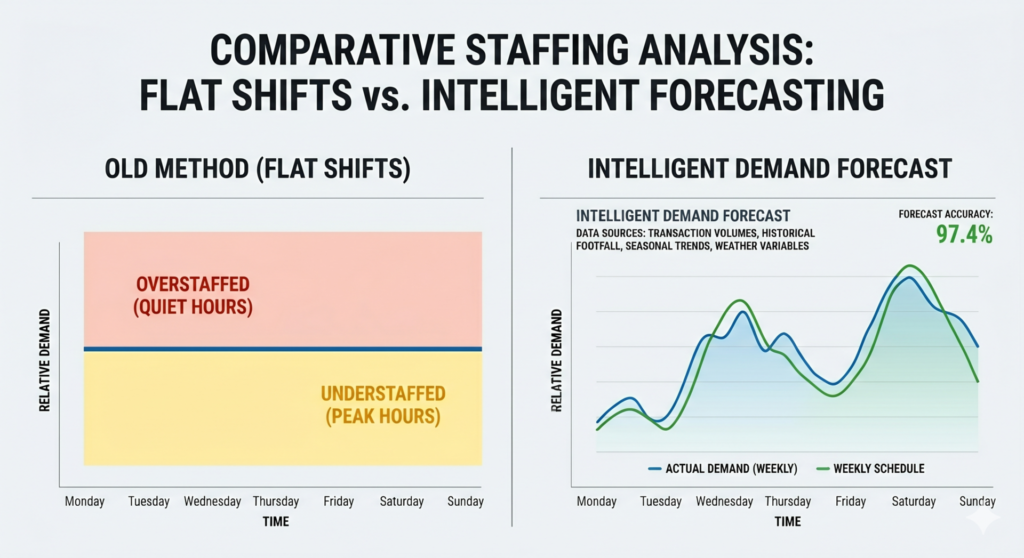
By leveraging historical footfall, transaction volumes, seasonal trends, and even external variables, intelligent systems generate highly accurate demand curves. For example, businesses may observe predictable increases in customer traffic during weekends and public holidays, seasonal fluctuations in demand, or recurring periods of higher absenteeism.
Such insights allow managers to schedule resources more effectively and ensure staffing levels are aligned with actual operational needs, ensuring you have the exact number of people on the floor exactly when you need them.
3. Supporting Better Cost Control
Labor is often one of the largest operational expenses for an organization. When labor planning is siloed and manual, financial leakages happen quietly across multiple departments and controlling labor costs becomes significantly more difficult.
These leakages don’t always show up clearly on a balance sheet as scheduling errors, but they reduce profitability. Common examples include:
- Unnecessary Overtime: Calling in staff at premium rates because managers lack real-time visibility into available full-time staff in other locations, or part-time or casual pools waiting for work
- Time Creep: Minor inaccuracies in manual clock-ins and paper timesheets that inflate payroll expenses
- Administrative Overhead Waste: The hidden cost of a manager’s time. Spending 5 to 10 hours every week manually calling staff, managing shift-swap logistics on WhatsApp, and cross-referencing spreadsheets is expensive
Data driven workforce planning helps organizations understand exactly where labor costs are being incurred and why. Access to dashboards to identify cross-departmental redeployment opportunities, or monitoring workforce metrics such as overtime trends, staffing utilization, and attendance patterns, managers can identify opportunities to optimize workforce deployment and reduce unnecessary spending.
4. Improving Employee Retention
In today’s highly competitive labor market where labor shortage is common, staff retention is a primary goal. One of the fastest ways to damage employee morale is the perception of unfairness or inconsistency in the schedule. When rosters are built manually, human bias or simple oversights can lead to unequal shift distribution, repeated allocation of undesired shifts, consecutive demanding rotations, or ignored leave preferences.
Over time, these scheduling frustrations can significantly impact employee engagement and increase turnover risk.
Data-driven workforce planning introduces greater transparency and fairness into the scheduling process. The system analyzes the entire team’s availability, contracted hours, leave balances, and shift preferences to distribute shifts objectively and evenly.
Organizations can also use workforce data to identify early warning signs of employee fatigue, excessive overtime, absenteeism, or burnout. Rather than waiting for employees to resign or disengage, managers can proactively intervene and make adjustments.
When staff see that the schedule is balanced, fair, and respects their work-life harmony, they are far more likely to stay with the organization long-term.
Conclusion
As workforce challenges continue to grow in complexity, organizations need more than experience and intuition to make effective staffing decisions.
Data-driven workforce planning provides the visibility, insights, and forecasting capabilities needed to align workforce resources with operational demand. It enables organizations to improve labor utilization, control costs, reduce workforce inefficiencies, and make more informed decisions.






 622 Lor 1, Toa Payoh
  sales@workforceoptimizer.com