

Overtime is often necessary to maintain business continuity, especially in industries that operate around the clock. However, when overtime becomes a routine solution rather than an exception, it can significantly increase labor costs and place unnecessary strain on employees.
Many organizations accept overtime as an unavoidable operational expense. When sudden spikes in demand happen or a team member calls in sick, authorizing a 1.5x or 2x premium rate feels like the only way to keep the lights on and maintain service standards.
In reality, excessive overtime is often a symptom of deeper workforce planning challenges, such as inaccurate staffing forecasts, inefficient scheduling practices, and limited visibility into workforce availability.
By adopting smarter workforce planning strategies, organizations can reduce overtime dependency while maintaining service quality and operational efficiency.
1. Inaccurate Staffing Forecasts
One of the most effective ways to reduce overtime is by ensuring staffing levels are aligned with actual business demand. When an unexpected surge hits, the floor is immediately understaffed, forcing managers to extend shifts at premium rates. Or when the floor is overstaffed, staff are idle and not utilized well.
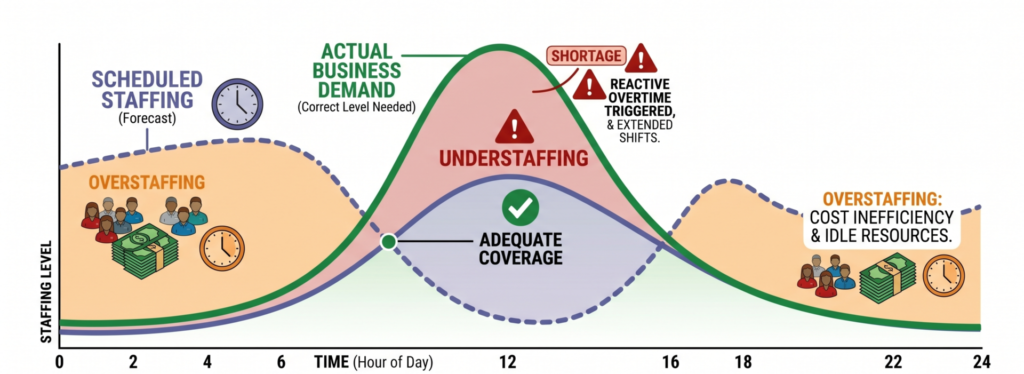
Smarter workforce planning uses data-driven demand forecasting. By analyzing historical transaction volumes, footfall, or queue/sales data, intelligent systems predict exactly when you will need more hands on deck. This allows you to build a schedule that mirrors your true demand curve, ensuring you have adequate coverage during peak hours and preventing the last-minute panic that triggers overtime spend.
Organizations can better anticipate staffing requirements and schedule resources accordingly. When the right number of employees are scheduled at the right time, the need for reactive overtime is significantly reduced.
2. Real-Time Redeployment
A lack of workforce visibility often contributes to unnecessary overtime spending. An understaffed manager will call in off-duty staff or ask staff to extend their shift on overtime rates, simply because they cannot see the available internal resources nearby.
In a modern workforce management platform, if an unexpected shortage occurs in “Location A,” a manager can instantly see that “Location B” is currently overstaffed with eligible employees. Moving an underutilized staff member to cover a high-demand area maximizes labor utilization and completely bypasses the need for premium overtime pay.
This level of visibility becomes even more valuable for organizations operating across multiple sites, departments, or outlets. Instead of treating each location as an isolated workforce, managers can make staffing decisions based on the organization’s total labor pool.
Real-time redeployment not only reduces overtime expenses but also improves workforce utilization by ensuring available employees are deployed where they are needed most
3. Maximizing the Casual and Part-Time Labor Pool
When an open shift needs to be filled urgently, managers typically call the employees they know best, often full-time staff who quickly enter overtime territory. Meanwhile, part-time or casual employees who are actively looking for extra hours remain underutilized.
You can now democratize the open-shift process. When a gap opens up, managers can broadcast the shift to a pre-approved pool of part-time or casual staff via a mobile app. Eligible staff can then express interest or claim the shift directly, reducing the need for manual phone calls and coordination.
This creates a larger pool of available labor that can be mobilized quickly using standard hourly rates rather than premium overtime rates. It also benefits employees who want greater flexibility and additional earning opportunities.
4. Implementing Overtime Guardrails
When managers are manually piecing together complex weekly schedules on spreadsheets, it is incredibly easy to accidentally assign a shift to an employee who is already tracking toward their maximum weekly hours.
Modern workforce planning systems solve this by embedding compliance and budgetary rules directly into the scheduling engine. The system acts as a digital guardrail that helps managers make more cost-effective workforce decisions.
- Real-time alerts: Instantly flags a manager if they attempt to schedule an employee into an overtime threshold
- Smart filtering: Automatically ranks available replacement staff by their regular hourly cost, prioritizing part-time or casual workers who haven’t hit their hour caps yet
Some organizations also implement overtime approval workflows, ensuring overtime requests are reviewed and justified before additional labor costs are incurred.
Conclusion
While overtime will always play a role in managing unexpected operational demands, it should not be the primary solution to workforce shortages.
Reducing overtime isn’t about forcing your team to do more with less; it’s about utilizing the workforce you already have more effectively. By transitioning from manual, siloed scheduling to automated, demand-driven planning, you eliminate the operational blind spots that quietly drain your labor budget.
Is unbudgeted overtime quietly eroding your profit margins? Workforce Optimizer’s AI-powered scheduling engine helps organizations predict demand, enforce compliance guardrails, and cut unnecessary labor costs. Speak to our team today to learn more.





 622 Lor 1, Toa Payoh
  sales@workforceoptimizer.com